Mergers that Matter: The Impact of M&A Activity in Prescription Drug Markets
Accepted, Journal of Political Economy Microeconomics
Additional documents: 2023 HSR comment letter(PDF) · Data
Media: Chicago Booth Review
Policy citations: HHS ASPE report (2025)
M&A Activity in the Pharmaceutical Market
Consolidation in the pharmaceutical industry has come under increasing scrutiny, with some policymakers raising concerns over the possible role of M&A in the significant growth of drug prices. The Federal Trade Commission (FTC) is particularly concerned that “cross-market” acquisitions (which do not involve competing drugs) may lead to higher prices, which could happen if manufacturers are able to bundle drugs treating different diseases when bargaining with payers. However, despite the importance of this topic, empirical evidence on the effect of pharmaceutical M&A is relatively scarce.
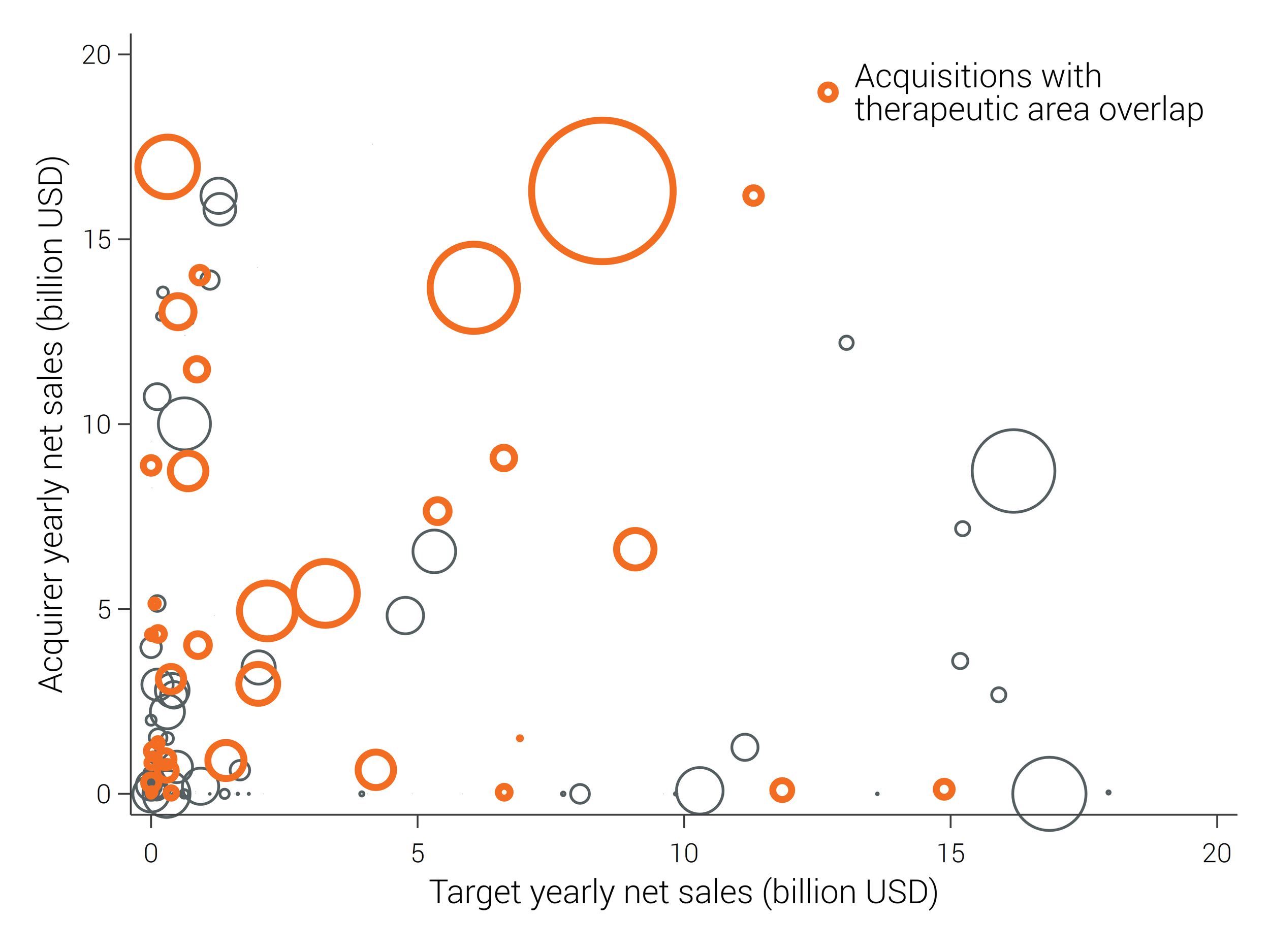
We construct a novel dataset tracking the holder of US marketing rights for the vast majority of branded drugs between 2007 and 2019 and document several patterns:
- Acquisitions are extremely common: the marketing rights of over one-fourth of branded drugs are traded at least once during our sample period.
- Only one-fourth of acquisitions involve drugs in the same therapeutic area. The rest are cross-market acquisitions.
- Very often, the company selling marketing rights to a drug retains the underlying IP. These licensing deals are not usually included in traditional M&A databases but represent around 30% of pharmaceutical deals.
Empirical Methodology
We use data on net prices (from SSR Health) and insurance coverage (from MMIT Analytics) to study how acquisitions affect access to prescription drugs. We analyze each acquisition separately and estimate its impact on prices through a series of event studies. As comparison groups, we select drugs in the same broad anatomical category (e.g., cardiovascular) that were not acquired and have similar age and revenue as the acquired drug. We then plot the distribution of the coefficients we obtain and compare them to a placebo distribution derived by running the same event study analysis on drugs that were not acquired.
The Effect of Horizontal Acquisitions
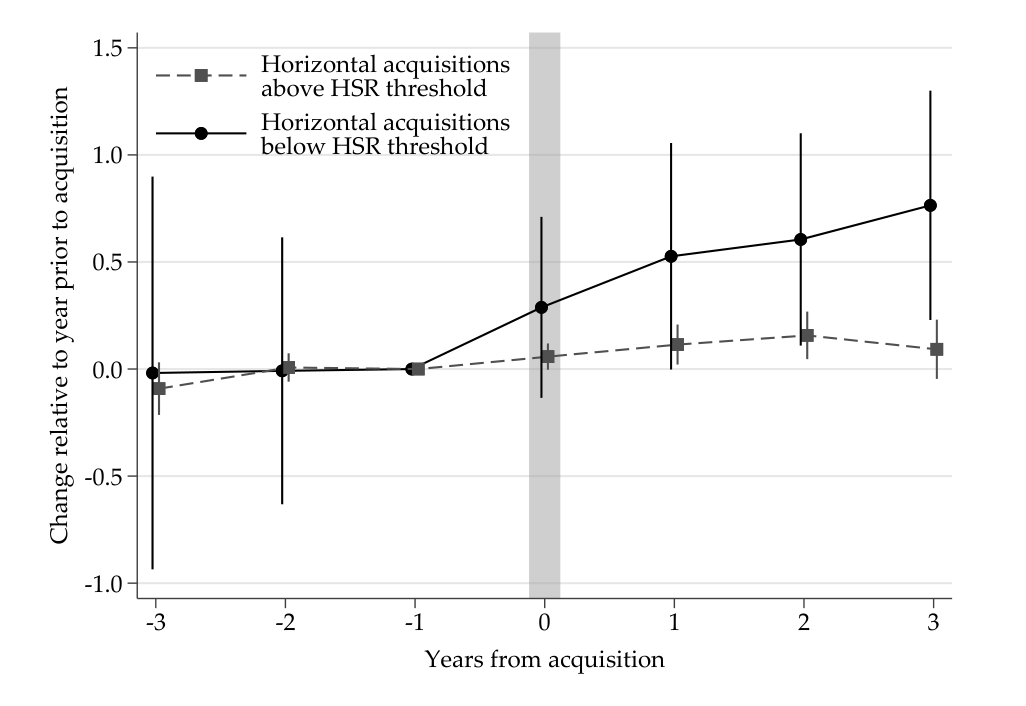
Horizontal acquisitions (i.e., acquisitions that consolidate ownership of drugs in the same therapeutic area) lead to higher prices on average, but these price effects are concentrated among a small group of low-value acquisitions that escape regulatory scrutiny.
These acquisitions are small enough to be exempt from disclosure to the FTC, so they are not subject to regulatory scrutiny. Conversely, acquisitions above a certain size must be disclosed in advance and risk being blocked if the FTC believes they are harmful to consumers.
- Low-value, “stealth” acquisitions are followed by an average 88% price increase.
- Disclosed acquisitions are followed by a much smaller increase in price (13% on average).
The Effect of Cross-Market Acquisitions
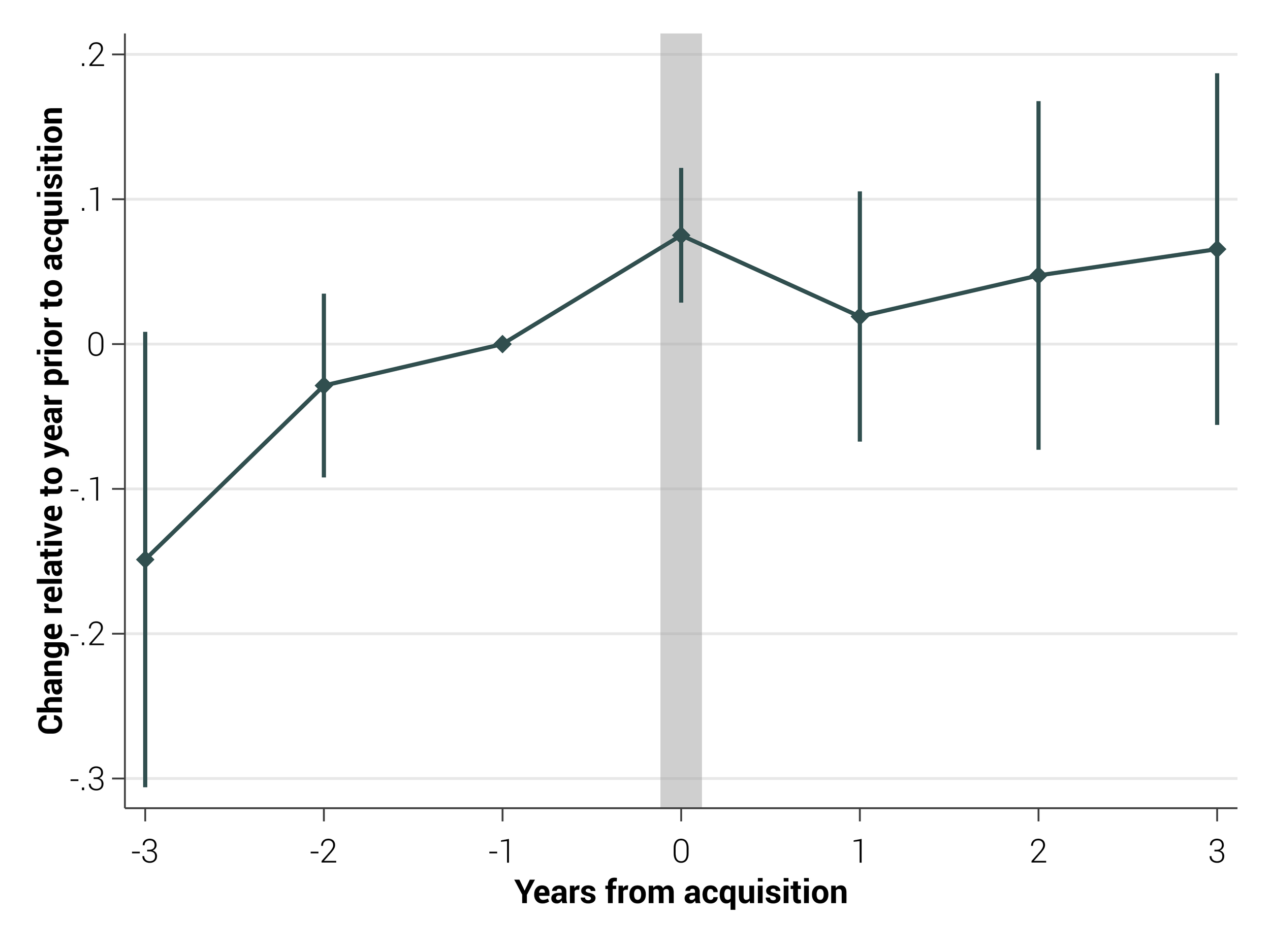
Recent bargaining theories suggest that, under some conditions, firms with large portfolios may be able to extract higher prices from payers by selling their products as a bundle. To test whether this happens in the pharmaceutical market, we look at what happens when a drug is acquired by a larger company.
Cross-market acquisitions by larger companies are followed by a small and noisy increase in price, with noticeable pre-trends.
Using formulary data, we show that even though exclusions are relatively common (between 15% and 20% on the average commercial formulary), company portfolios are almost never fully excluded. This suggests that drug manufacturers do not systematically negotiate over their entire portfolio of drugs but instead conduct class-by-class negotiations.
Key Takeaways
- Regulatory scrutiny matters: deals that are disclosed to the FTC have a smaller impact on price.
- Cross-market acquisitions do not appear to have an inflationary effect on price on average. However, we do find price increases of about 20% after a small subset of especially large deals: acquisitions of top-selling drugs, or deals that significantly expand the portfolio of the acquiring company.