Stocking Under the Influence: Spillovers from Commercial Drug Coverage to Medicare Utilization
Working paper (revisions requested at American Economic Review)
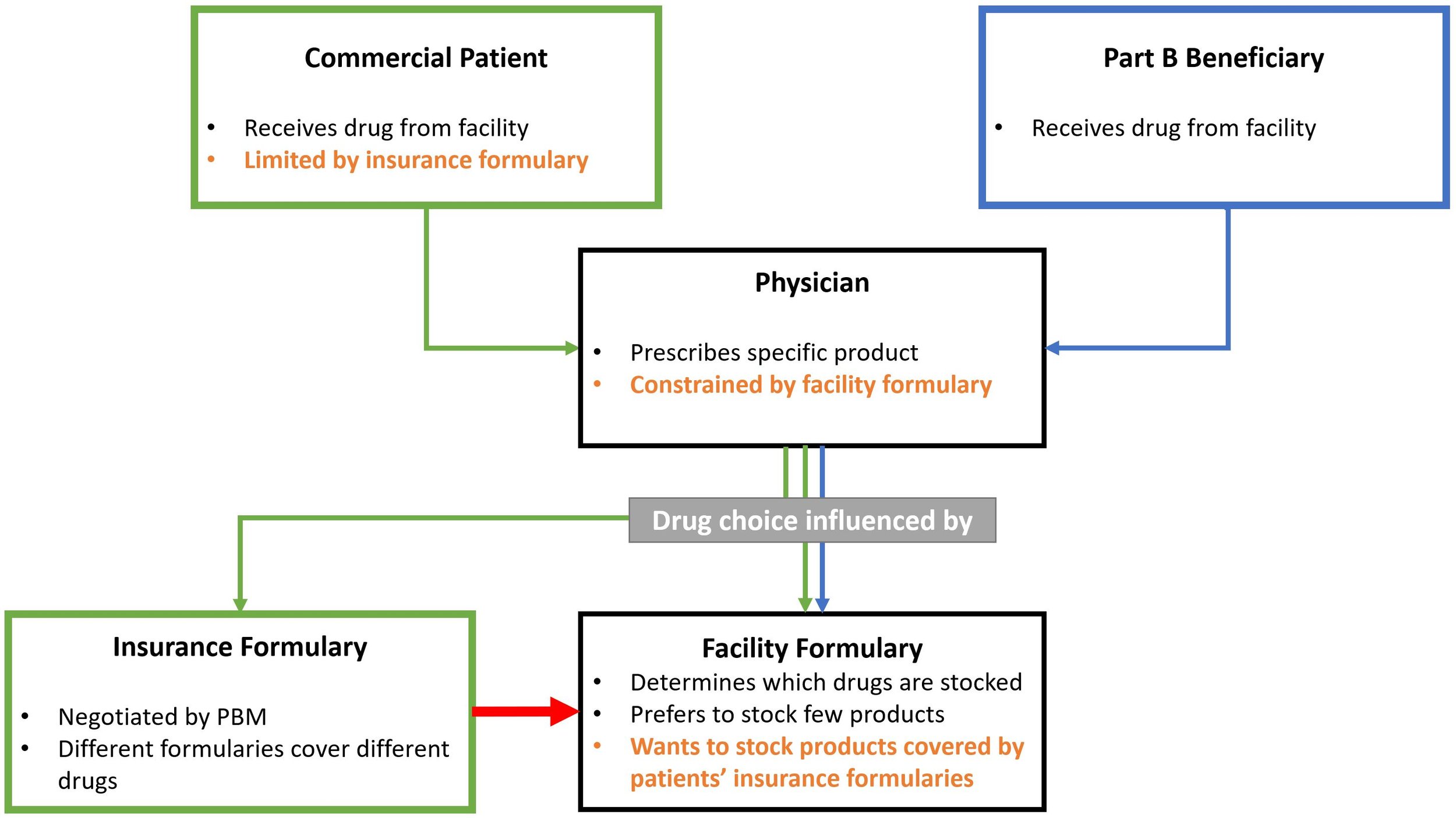
Physicians administering drugs in an outpatient setting (e.g., hospital outpatient departments and physician offices) need to account for restrictions from two types of formularies: the prescription drug formulary of the patient’s health plan and the formulary of the facility where the doctor is prescribing.
- Prescription drug formularies are tiered menus listing all drugs covered by the health plan. Tiers determine the out-of-pocket cost to the patient. Manufacturers obtain better tier placement by granting higher rebates to payers. To encourage more aggressive competition on rebates, drug formularies often exclude drugs with close substitutes.
- Facility formularies determine what drugs are stocked in the facility. Facilities restrict formularies to unlock additional discounts from manufacturers through volume or percentage-based guarantees.
When deciding which products to include on the formulary, the facility is incentivized to favor drugs broadly covered by commercial drug formularies to avoid situations where a patient receives a drug not covered by her health plan. This incentive creates a spillover effect from commercial drug formularies to facility formularies. In turn, because facility formularies determine what is administered to all patients receiving care in that facility, this spillover effect introduces a channel through which equilibrium outcomes in the commercial market can influence the utilization of patients in government-sponsored plans, such as Traditional Medicare.
Testing for the Spillover Effect of Commercial Coverage
To confirm the existence of this spillover effect, we relate commercial formulary coverage to utilization in Medicare Part B in two samples of physician-administered drugs (2015–2019): a core sample of all branded physician-administered drugs, and a sample of reference biologics facing biosimilar competitors. Since unobserved preferences could drive both commercial formulary coverage and Part B utilization, we use an instrumental variable strategy that leverages coverage changes in national formularies—stock products that Pharmacy Benefit Managers sell across the entire US.
We find that a 10pp increase in commercial exclusion rates lowers a drug’s market share among Medicare Part B beneficiaries by 0.9–1.7pp. The baseline IV specification implies a 1.7pp decline; the paper’s preferred, more conservative specification—which adds brand-year fixed effects to absorb national demand shocks—implies 0.9pp. The effect is economically meaningful: for a drug with two equal-share competitors earning half its revenue from Traditional Medicare, exclusion by a payer that cuts commercial coverage by 25pp costs about 2.3pp of Medicare market share—a 3.5% revenue loss purely from the spillover.
| (1) | (2) | (3) | (4) | |
|---|---|---|---|---|
| Panel A. OLS estimates | ||||
| Fraction Excluded | -0.091 | -0.035 | -0.014 | -0.014 |
| (0.011) | (0.011) | (0.010) | (0.010) | |
| Panel B. Shift-share IV results | ||||
| Fraction Excluded | -0.174 | -0.197 | -0.093 | -0.093 |
| (0.030) | (0.032) | (0.033) | (0.033) | |
| Weak-identification F-stat. (Kleibergen–Paap) | 418.4 | 405.7 | 129.9 | 129.9 |
| N | 16,114 | 14,363 | 16,114 | 16,114 |
| Open Payments & ASP Controls | X | X | ||
| Brand-Year FE | X | X | ||
Facilities, Not Physicians, Drive the Results
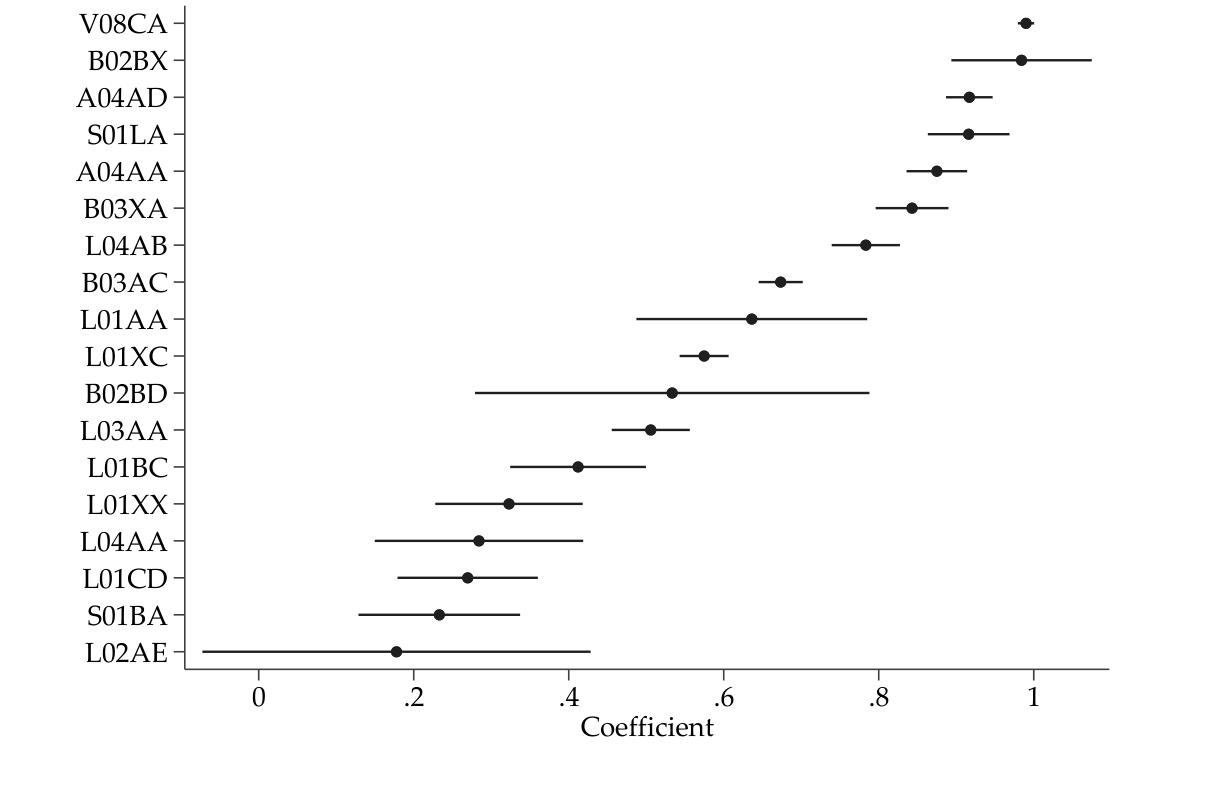
The result is driven by facility-level factors. Focusing on physicians who practice in two facilities in the same year, we compare within-physician prescribing across the two facilities: physicians largely mimic each facility’s overall prescribing mix rather than carrying their own preferences with them. Across substitution classes, facilities account for 20–100% of the variation in product market share—and for 80–90% in classes made of a reference biologic and its biosimilars, where products are closest to interchangeable. Consistent with the stocking mechanism, the link between commercial coverage and Part B utilization is much stronger in the drug classes where facilities drive more of the variation.
A Two-Layer Model of Coverage and Stocking
Motivated by these findings, we build a model of price competition between two drug manufacturers that incorporates both commercial formulary coverage (won through rebates to insurers) and exclusive facility stocking (won through discounts to facilities), and calibrate it to a market with one reference biologic and one biosimilar competitor (epoetin alfa). The calibrated model shows that the reference biologic has large built-in advantages stemming from patient, facility, and insurer preferences, which is the primary reason it keeps a dominant market share despite being more expensive. We then simulate three policies aimed at improving biosimilar adoption:
- Raising Medicare’s add-on fee for biosimilar administrations (from 6% to 8% of the reference product’s ASP, mimicking the 2022 Inflation Reduction Act policy) has virtually no effect: facilities’ stocking choices are dominated by the much more profitable reimbursements on the commercial side, so Medicare’s lever barely moves them.
- Mandating open commercial formularies backfires: with the coverage layer shut down, the reference biologic competes more aggressively on price in the stocking game and successfully retains its advantage—the biosimilar’s market share actually falls slightly—while commercial spending rises.
- A biosimilar coverage mandate shifts commercial market share toward the biosimilar (from 39% to 51% in the calibration) with little change in overall spending.
Key Takeaways
- Commercial-market equilibria shape the care received by patients in government-sponsored insurance—direct evidence for the “commonality of care” hypothesis: patients treated at the same facility receive similar care regardless of who insures them.
- The stocking channel weakens Medicare’s policy levers. Reimbursement reforms have limited effects on utilization and spending because commercial insurers, not Medicare, dominate facilities’ stocking incentives.
- Restricting competition in one layer intensifies it in the other: coverage mandates trigger tougher price competition over stocking, blunting their intended effect on adoption.
- Changes in prescribing that look like physician behavior may actually reflect facility-level decisions. Policies aimed at altering physician behavior (e.g., letter campaigns) may prove ineffective when facilities set the menu.